Friday, May 20, 2011

Mike Licona on Training Children

A great article by Mike Licona of the North American Mission Board, on training up the next generation, especially those in your house.

FIRST-PERSON: We must prepare the next generation to defend the faith
Mike Licona

ALPHARETTA, Ga. (BP)--I have a confession: I failed as a parent to prepare my children to defend their Christian faith. My failure is especially embarrassing because I'm a Christian apologist.

Since apologetics is a rational defense of the Christian faith, I travel around North America and sometimes outside it sharing the remarkable historical, scientific and philosophical evidence supporting the truth of the Christian faith. I equip Christians with evidence so they may have a strengthened faith they can share confidently with others. Through lectures and public debates I also challenge seekers of truth to give the evidence a fair look and become a Christ follower.

Yet, I never equipped my own children. There were two reasons why. I'm not discounting a bit of laziness on my part, but my wife and I have always wanted the faith of our children to be their own and not ours. And we made the huge mistake of assuming their youth pastors would occasionally touch on Christian evidences. I was shocked about two years ago when I asked both of my children how often they had received teaching related to Christian apologetics during their Sunday School classes and youth group meetings. Answer: Never. Not once? Zero. Zilch. Nada.

This void was even more alarming when I realized that our family had been members of several churches during their lifetimes. So, it wasn't the neglect of a single youth leader. What were their leaders teaching? Admittedly, they didn't remember much. They played video games, other games, did fun things, had nice periods of worship, and received Bible lessons that, for the most part, they didn't recall.

Did their youth pastors drop the ball on preparing them adequately to withstand the attacks on their faith they would experience when they went off to college? Yes. But the buck stops with Dad. I failed and I admit I'm embarrassed because, of all people, the children of an apologist should know the evidence.

Let's take a moment and look at the situation in which our children find themselves. This will help us to see why it's important to equip them with both evidences and answers to the difficult questions. University campuses are growing increasingly hostile toward evangelical students. A 2007 report by two Jewish researchers found a strong bias against evangelical students at secular universities.[1] More than 1,200 faculty members from 712 colleges and universities were interviewed pertaining to their feelings toward various religious followers. The results were alarming. Three percent of American faculty members admitted having negative or unfavorable feelings toward Jews while 33 percent admitted having them toward Muslims. But 53 percent admitted having negative or unfavorable feelings toward evangelical Christians. The researchers concluded, "Conservative Christians have for some time been concerned about their children's campus environment. These data certainly legitimize their concerns."

But it didn't stop there. To their shock, these Jewish researches likewise discovered that a significant number of American faculty members want Muslims to play a greater role in the American political process while wanting evangelicals to stay out of it. But why? After all, generally speaking, most Muslims are pro-life, against homosexual marriage and women's rights, at least as they are enjoyed by American women. To me, this suggests we are in much more than a cultural war between political conservatives and liberals. It goes beyond secularism and the religious. On many of our college campuses, it is a war against evangelical Christianity.

I personally have had numerous students from all over North America inform me that professors, on the first day of class, said their objective was to rid Christian students of their faith by the end of the semester. That's right. The professor openly stated in class that his or her objective was to rid Christian students of their faith within the next hundred days. Can you imagine what would happen if those same professors had instead asked how many of his or her students were Muslims ... or Jews? They would have been labeled "Islamaphobe" or "anti-Semite" and would soon have joined a number of others in the job market. But faculty members often get a pass if they're a "Christophobe."

Some good news is that a large number of Christian college students have a strong interest in apologetics, which is now a necessary component for nourishing students for a healthy faith and continuous growth in a vibrant walk with Christ. Some of these students will become church planters, missionaries, pastors, youth pastors and seminary professors. However, if we neglect familiarizing our college students with apologetics now, will we find far fewer members in SBC churches 20 years from now? From where will our next generation of church leaders come?

The North American Mission Board has created free apologetics resources. At
4truth.net, viewers have access to nearly 200 articles and can listen to more than a dozen interviews with leading scholars and scientists. Most of the articles are available in five languages. We recently posted a five-part video series with discussion questions for use by groups and individuals on the topic of the historical evidence for Jesus' resurrection. NAMB also has a certification program in apologetics.

Church planters, pastors, and BCM leaders can benefit from nearly a year's supply of free PowerPoint presentations on apologetics topics we have created for them. [Please contact your state director of evangelism or director of missions for information on how to obtain these.]
--30--
Michael Licona is the apologetics coordinator at the North American Mission Board.


A good article and a wake up call to the church of Jesus Christ.

Thursday, May 19, 2011

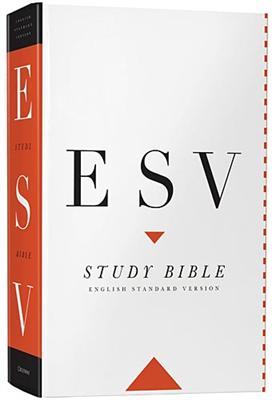
How to use a Study Bible.

How to Use a Study Bible
By Al Mohler

One of the most memorable purchases I made as a teenager was The Thompson Chain-Reference Bible in its original King James Version edition, complete with blue leather cover. I still have it, of course, though it now finds itself surrounded by a host of other Bibles on the shelf nearest to my desk. That study Bible opened the Word of God to me in a whole new way, helping me to make connections in the text and to see how subjects and themes run throughout the Bible.

That was my introduction to a study Bible. The chain-reference notes in that Bible took me throughout the Scriptures, reading text alongside text. I recognized this as a great improvement on Bibles that contained only a minimal index and a few maps in the back.


Today, there are several significant study Bibles, ranging from the most minimal, offering only cross-references, to others that offer the equivalent of several hundred pages of supplemental helps.


1. Read the text of the Bible first. Meditate upon the text and read it with care. Apply your own knowledge of the Bible in order to understand the particular text within its context and place in the biblical story-line. Consider and note other texts that come to your mind as directly related to this text. Read the text with full attention and conviction.

2. Look carefully at the cross-references that the study Bible links to the text you are reading. Do not look only to the citations, but read the actual passages. This assistance is still the main contribution of a study Bible — making related and parallel passages more accessible. A first principle of interpreting the Bible is to interpret the Bible by the Bible. In other words, to allow the Bible to interpret itself text by text.

3. As a third step, take full advantage of the notes, articles, and other helps printed alongside the text. In some cases, short articles will help in understanding contested issues or matters that might otherwise require a Bible dictionary or encyclopedia. Where appropriate, maps can be very useful, along with tables of measurement and similar points of reference. The very best of the study Bibles will also offer some level of commentary within the notes.

Of course, it is the Bible itself that is inspired, inerrant, and infallible — not the study materials included in study Bibles. Therefore, judge the notes by the biblical text, and never the other way around. Where possible, use more than one study Bible in order to maximize this learning process.

I am often asked for recommended Bible translations and study Bibles, so I offer this list in the hope that some will find it helpful. For the sake of simplicity I will recommend three excellent study Bibles representing the three translations I most eagerly commend.


The ESV Study Bible — This long-awaited study Bible redefines the category in terms of its sheer heft. Its 2750 pages (plus maps) represents a massive resource for personal Bible study. Based on the English Standard Version [ESV] of the Bible, this is a truly worthy contribution to the world of study Bibles. Under the direction of General Editor Wayne Grudem of Phoenix Seminary, the scholars who wrote and edited this study Bible have blended practical insights with keen theological reflection. The introductions to each book are well done, as is the pleasing and useful layout of the text and materials. This new study Bible will be warmly welcomed by those who pray to see more Christians grow in understanding the Bible. This is a study Bible for the serious Bible student and will serve any Bible reader well.


The MacArthur Study Bible — This well-known study Bible flows from the preaching and teaching ministry of Dr. John MacArthur, one of the most respected expositors of our era. I find this study Bible consistently helpful. Dr. MacArthur’s clarity and the simplicity of his explanations make this study Bible accessible to anyone, while the preacher or Bible teacher will find great usefulness as well. One key feature of this study Bible are his notes on the texts, especially the Old Testament, on which Dr. MacArthur has not yet written commentary in other forms. The MacArthur Study Bible, first released in the New King James Version [NKJV] of the Bible, is now (gladly) available in the New American Standard Bible [NASB] version.


The Apologetics Study Bible — This unique project is a study Bible that devotes particular attention to the apologetic issues that are confronted within the Biblical text. Under the general editorship of Dr. Ted Cabal of The Southern Baptist Theological Seminary, a team of scholars contributed, not only cross-references and the usual helps found in study Bibles, but also short articles on issues of current concern. The Apologetics Study Bible is based on the Holman Christian Standard Bible, another very trustworthy translation. I was honored to write one of the articles in this study Bible, and I commend it especially as a wonderful resource for students at the high school, college, and university levels. Those on the front lines of the apologetic confrontation will find great help here.

There are other worthy study Bibles, but these are the three I most heartily recommend. Any of these would make wonderful gifts at Christmas or any time of the year.

From http://www.albertmohler.com/2008/12/15/how-to-use-a-study-bible/

Wednesday, May 18, 2011

Has the Islamic state come to America?

Well what do you know? It seems that the Islamic state is working its way across America. What to do? What to do?


Lord help us.

Wednesday, April 27, 2011

Oneness and Trinity Debate!

Oneness adherent Steve McCalip debates Trinitarian Mark McNeil on whether the historic Christian concept of God is true or false. As the Athanasian Creed states, "We worship one God in Trinity, and Trinity in Unity; neither confounding the persons, nor dividing the substance. For there is one person of the Father, another of the Son, and another of the Holy Ghost. But the Godhead of the Father, of the Son, and of the Holy Ghost is all one; the glory equal, the majesty coeternal ... He therefore that will be saved must thus think of the Trinity." McCalip attacks the Trinity with practically every argument used by Jehovah's Witnesses, Muslims, Mormons & every other cultic sect known. Mark McNeil, however, is able to answer every argument Biblically proving why the doctrine of the Trinity has stood throughout time. Larry Wessels of Christian Answers (search BibleQuery.org) sponsored the debate.

Here is part one:


Here is part two:


This is an older debate but it is very good. Enjoy!

Friday, April 22, 2011

I Suffer not a Women....

Here is a short video where John Piper lays down a simple principle for determining if a women can teach to a group of men or not.


What do you think.

Monday, April 11, 2011

A post from the Flatlands.

Here is a post from the website of Flatland Apologetics run by Shelby Cade. It is quite good and should be read by every one. Enjoy!

APOLOGETICS _ A DEEPER MEANING:

No one debates the definition of apologetics. Apologetics come from the Greek, apologia, meaning to give a reasoned defense for Christianity. The classic verse used in referring to apologetics is 1 Peter 3:15. The English translation given (in the 1 Peter verse) is usually "defense" or "reason", both of which are good translations for the Greek, apologia. If the major word that is referenced is the word defense, does this represent all we need to know concerning apologetics? I believe that apologetics is more comprehensive than most individuals are willing to admit.


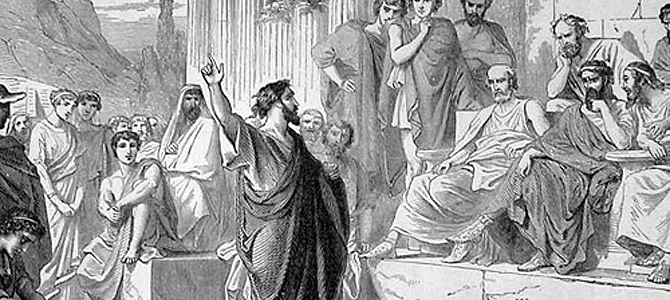
In order to get a comprehensive view of apologetics, the classic text of Acts 17 needs to be examined. There are three realizations to apologetics that the Church needs to grasp. Each of these realities relates to a more robust and accurate view of what apologetics is all about. The three realizations to apologetics that are often left out are critical for the Church to understand today. These three include:


1. Being able to argue in the correct manner - Most who hear the word argue instantly think of raised voices and veins popping out of the neck. The proper way to argue in some ways has been lost. Many, even in the Church, believe that arguing or debating is to be shunned. Paul had a different view to arguing. To argue means to articulate a view in order to defend or promote the worldview that an individual holds. Paul states, "The weapons we fight with are not the weapons of the world. On the contrary, they have divine power to demolish strongholds (2 Corinthians 10:4)." In this passage, Paul promotes arguments for truth. In Acts 17, Paul was disturbed at all the idols of Athens and felt compelled to form an argument for truth (Acts 17:16-17). As Paul argued, he did so in a calm manner that related the truth to those he was engaged with. Again, referring back to 1 Peter 3:15, the way to argue is to be done in a spirit of "gentleness and respect." Being able to argue in the correct manner is critical for the Church to understand and it is unfortunate that some in the Church don't realize the harm that can be caused by not heading the advise of Peter.


2. Apologetics is for the entire Christian community - What is meant by apologetics for the entire Christian community? Unfortunately, today many in the Church view apologetics as relegated only to the scholarly. Many feel that the Pastor or other lay leaders are to be solely responsible for articulating apologetic arguments. This way of thinking is not what what God's word promotes. Referring back again to 1 Peter 3:15, Peter tells all Christians to be ready to give a defense. In some ways the Church is weak because it has not realized the importance of apologetics in today's culture. Sure, Paul was a scholar, but Peter makes it clear that the entire Church needs to be responsible for being able to articulate the Christian worldview. What this means is that the Church needs to take its Christian responsibilities seriously. The prophet Hosea stated that God's people are destroyed for lack of knowledge (Hosea 4:6). If the Church continues to push its responsibility on a select few, it too will slowly be weakened due to its lack of Godly knowledge and its inability to argue for the Christian worldview. All Christians are to be apologetic ambassadors (2 Corinthians 5:20) Apologetic responsibility is for all who wear the name of Christ.


3. Apologetics is for the promotion of Christianity - When Paul was disturbed at the number of idols in Athens, he began to relate to people the truth of idol worship. Paul then defended and promoted the resurrected Christ. Apologetics does not stop at defense, but it tries to convince others of the truth concerning Jesus. Apologetics, properly understood is evangelical. Apologetics is not just limited to defense, but it also includes going on the offense for the good news of Jesus (Acts 17:29-34).
Posted by Shelby Cade

Sunday, April 3, 2011

A Few "Old Faithfuls."

I was on the Every Good Path website and found these:


And another:


And another:


And here:


And finally:


These are great resources and I am trying hard to teach my kids one called